High Speed Testing of Medical Devices and Materials

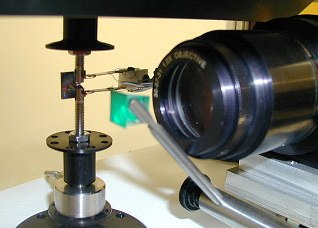
An important input to FEA is material characterization and limit information.  In our laboratory we use  a Bose 3230 test system for achieving test speeds up to 200Hz.   Depending on the project, we may test complete devices, sub-components, coupon samples and/or simple material characterization samples.  Many times, we will test more than one [...]

The Selection of Nitinol Material Models for FEA Simulations

Nitinol is a unique metallic alloy that is ideally suited to use in medical devices.  It has excellent biocompatibility and most of all it has the ability to undergo significant recoverable deformations.  This allows devices made with Nitinol to be reduced to catheter dimensions and expanded at the implant site.

Much work has been done to [...]

Metallic Medical Implant Material Fatigue Research

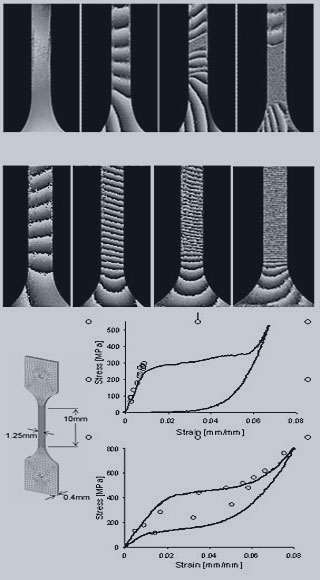
With the growing use of Nitinol in medical implants, there is a need for improved characterization of the material behavior of Nitinol and methodologies for better product design and engineering. While it is a good starting point, the typical approach of employing the force-deformation response from uniaxial tension tests for input and validation of material [...]

Suture Clip for Percutaneous Mitral Valve Repair


This is a picture of an excised mitral valve from a pig with suture and a clip holding the leaflets together in a novel approach to treating mitral valve regurgitation.  It was placed percutaneously using a specially designed catheter.  The superelastic Nitinol clip was designed and developed using Finite Element Analysis (FEA).


You can download the patent protecting this [...]

Computing Alternating and Mean Stresses During Fatigue for a Cardiovascular Stent

Finite Element Analysis (FEA) is routinely used to perform fatigue analyses of cardiovascular stents.  For the case of balloon expandable stents, this means modeling the crimping of the stent onto the delivery balloon, the expansion and recoil of the stent as would occur during deployment and finally the simulation of fatigue deformations.  Fatigue deformations typically [...]

ASTM Standard for FEA of Metallic Vascular Stents

Follow this link to the ASTM website and find the long awaited for “Standard Guide for Finite Element Analysis of Metallic Vascular Stents Subjected to Uniform Radial Loading”.

This guide establishes general requirements and considerations for using finite element analysis techniques for the numerical simulation of metallic stents subjected to uniform radial loading. These stents are [...]

Comprehensive Fatigue Analysis: Complex Loading of Implantable Medical Device

Medical device manufacturers are increasingly required to demonstrate that their products are safe and effective when subjected to complex loading conditions in the human body such as when the device may experience combinations of bending, twisting and compression.  Physical test methods are difficult to implement in such cases, can only consider a finite number of [...]

Carotid Artery Stent Fractures: An Engineer’s Perspective

You can download my presentation at the 2007 Cleveland Clinic Stent Summit on carotid artery stent fractures from an engineers perspective which discusses combined loading conditions, fatigue, material limits and other factors.

Characterization of Nitinol Material Behavior for the Design and Validation of Medical Implants

Direct strain measurements in AAA stent using phase shifted moire interferometry.

You can download a poster I presented at the MPMD fall 2007 conference illustrating our method for characterizing Nitinol material behavior for the design and validation of medical implants.

Real Time Moire Interferometric Measurements of Nitinol Fatigue

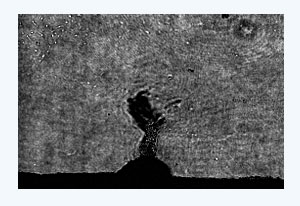
You may view an animation in real time of a crack growing in a Nitinol fatigue specimen observed using moire interferometry while the test was being conducted in our Bose Electroforce test machine that shows a moving transformation zone and perceptible fringes captured at 30 frames per second.