DrPerry.org

  • rss
  • Home
  • About
  • Sitemap
  • Contact

FEA and the FDA

Dr. Perry | June 3, 2009

I just returned from a workshop sponsored by the FDA (and the NHLBI and NSF) on Computer Methods for Cardiovascular Devices.  It was an excellent workshop providing an audience of regulatory, academic and industrial interests a chance to get caught up on the state-of-the-art, trends and, in general, to exchange ideas on the issues of using computational methods to support regulatory filings for medical devices.  A general theme emerged for me during the workshop that I’d like to discuss in this article:

We are not providing the FDA with adequate validation of our computational models!

For years now I’ve been helping companies demonstrate the safety and effectiveness of their products.  I’ve written many FEA reports that have been reviewed and accepted by the agency, including cases where we’ve argued to forgo expensive and time consuming durability testing in lieu of providing computational results to support safety claims.  It has been my experience that the FDA has been very open to such an approach, provided there was an adequate demonstration of the validity of the FEA models.

From what I heard from reviewers at the workshop, however, the typical submission of FEA results does not include adequate validation.  I don’t know if it is because companies don’t know how or what to provide for validation of their FEA models or if they are reluctant to share testing or data that the FDA has not specifically asked for or if they have unreasonable expectations about what computational models can replace in terms of physical testing, but it is clear to me that if we want to leverage FEA to streamline the development and approval process then we need to take a proactive role at demonstrating how well our models describe our products.

It is far less expensive and time consuming to perform carefully designed bench tests to validate computational results than it is to run long term durability tests on our devices and hope they pass.  Not to mention far less risky from a product development perspective.  It was clear in the workshop that the FDA understands this and that they too are motivated to see a better balance between physical testing and computational modeling in a submission.

Still, as open and receptive as the FDA may be,
they are not in a position to advise on how best to perform the appropriate validation.
As engineers we need to establish the validity of our computational models and we need to do so BEFORE we submit results to the FDA.  In fact, we need to begin this effort early in the development process before we start making decisions based on our computational data.  Otherwise, how can we expect the FDA to accept that our results have emerged from a rigorous engineering methodology?

How much and what type of validation is necessary in any given case depends on how a model is going to be used.  Conversely, the confidence we have in a computational model depends on how extensively it has been applied and shown to agree with reality.  There are numerous opportunities we have during the development process to establish the validity and range of our computational models.  Radial force testing of different stent designs for example provides an excellent opportunity to confirm our models ability to predict reality.

In summary, the time is right for advancing the use of computational models for demonstrating the safety of our products.  But we need to be proactive and utilize models that are well grounded in experimental data.  How far we are able to leverage these results with the FDA will depend on how good of a job we do at convincing them that they represent actual experience.

Share/Save/Bookmark

Comments
No Comments »
Categories
Engineering, Innovation
Tags
Design, FDA, FEA, Medical, Stent, Stents, validation
Comments rss Comments rss
Trackback Trackback

Identifying Worst Case Device Sizes

Dr. Perry | May 6, 2009

For medical devices, rarely does “one size fit all”.  The human body is extremely variable and patient populations, especially those with disease present a wide range of differences that the medical device design engineer must consider.

Identifying the worst case size for a product family is an important part of the validation process for implantable medical devices.  Understanding your product and especially the in vivo loading conditions are essential for engineering the structure and material specifications for each size over the intended product range.

Typically, there are numerous sources of nonlinearity associated with implantable medical device design.  The materials we use, the geometries and especially the physiology we treat all respond in ways that are difficult to describe in simple terms.  It is tempting to design a product by considering an idealized patient population and then simply “scale” that design to smaller and larger sizes.  But this approach can can result in a poorly optimized product family.  Furthermore, when one considers device/lumen ineraction and teh resulting compliance under physiological loads, identifying the worst case loading condition is not a straightforward activity.

The figure above illustrates how the alternating fatigue strain for a stent-like product can vary for deployment to different diameters.  It is based on an analytic model of lumen compliance and finite element analysis models of the two device sizes.  Clearly, the results indicate a highly nonlinear system that precludes the selection of a single worst case device size and implant condition based on the “four corners” approach.  Assuming that the largest device put into the smallest lumen will result in the most challenged loading condition is niave.

When it is possible, it is preferred to model ALL device sizes to determine the worst case size. It is also advantageous to develop and validate a simulated model of the intended physiology for the implant and use this model to verify the performance of each size in a design family.  Parameters such as radial force, anchoringg, dynamic compliance, vessel tortuosity and fatigue loading conditions can then all be evaluated for each device size and safety established for the complete instructions for use (IFU) for the product.

Share/Save/Bookmark

Comments
No Comments »
Categories
Engineering
Tags
Design, Fatigue, Materials, Medical, nonlinear, Optimization, validation
Comments rss Comments rss
Trackback Trackback

FEA of NIKE AIR

Dr. Perry | April 29, 2009

My first job out of graduate school and post-doctorate work was with the footwear company, NIKE.  I was fortunate to hire into the heart of the most advanced footwear technology department in the world and I could not have had a more exciting job description.  I began by learning how to design NIKE AIR cushioning bladders.  After becoming familiar with the design and development process I was able to make my first contribution, which was to pioneer the use of Finite Element Analysis to predict the inflated geometries of NIKE AIR bladders.

The engineers in the NIKE AIR Technology Lab were very proficient at design and had established an efficient process for prototyping new designs-at least for components based on flat film and lay-flat tubing.  However, blow molded AIR bladders which were becoming quite popular required building mold tooling prior to prototyping.  A design tool that allowed the refinement of a design prior to cutting tools was needed.  These molds were expensive and involved several weeks of lead time.  The biggest benefit of an FEA method, however, was the ability to predict the geometry of the bladders so that midsole tooling could be made for production.  The current practice was to inflate ten AIR bladders, set them aside, allow them to equilibrate for 6-8 weeks and then measure them with calipers.  Several mechanisms affected their change in shape but viscoelastic creep was primarily responsible for the time dependent shape change.

There had been several previous attempts to predict the inflated geometries of NIKE AIR bladders prior to my working at the company.  It was generally believed that FEA would not be able to predict inflated geometries with sufficient accuracy.  Furthermore, the viscoelastic behavior of the urethane elastomers was considered too complicated to characterize.  Having been an ardent experimentalist challenging FEA codes for advanced elastic-plastic fracture and rock mechanics problems, I thought for sure that we would be able to utilize FEA for NIKE AIR bladders.

Force deflection data was available for the NIKE AIR bladder material but before I embarked on fitting that data to a hyperelastic model, I was curious to know what strain levels were associated with an inflated bladder.  One of the first things I did was to scrounge up some polarizing filters and rig up a crude polariscope to estimate the strain in the film of an inflated bag.  My estimate surprised me—less than 1% strain.  I verified my measurement using a grid method and sure enough, the strains were really that low.  (I also explored using mercury strain gages for directly measuring strains with some success.)

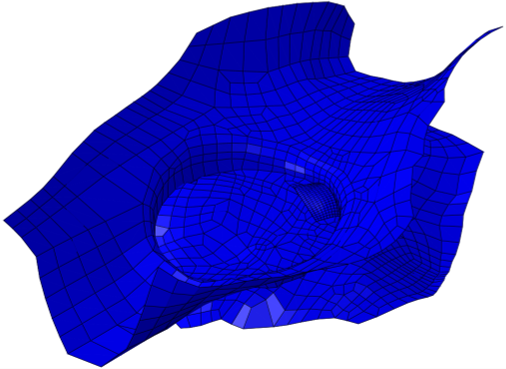
Armed with this simplification, some basic creep data for urethane, and the help of some software vendors, I was able to demonstrate excellent predictive ability of FEA in determining inflated AIR bladder shape and growth over time.  The application of FEA helped reduce product development lead times and significantly decreased the cost and time to develop complex blow molded designs.  This last figure illustrates how FEA could help identify “hot spots” that would not inflate uniformly.  I have since left NIKE and the AIR Technology Lab but not before seeing a whole department grow up to apply FEA to cushioning technology and many other aspects of footwear and athletic equipment.

Share/Save/Bookmark

Comments
No Comments »
Categories
Engineering, Innovation
Tags
Design, FEA, Materials, NIKE
Comments rss Comments rss
Trackback Trackback

Contact Interaction for Medical Implants

Dr. Perry | April 25, 2009

There are many circumstances when it is necessary to model contact and contact interactions when analyzing medical implants.  Such circumstances arise when devices interact with tooling, catheters, vessels and when self-contact occurs.  This latter situation arises for example when a stent is crimped down tightly to catheter dimensions.

ABAQUS/Standard provides a range of methods for defining and managing contact in FEA simulations.  One first defines a master surface and a slave surface which can be based on node or elements sets and/or analytically defined surfaces.  Then one must select a contact interaction model and ascribe specific properties to that model.  The image on the left shows both node and element sets used in a typical contact definition for self-contact of a stent.

Considerable care must be used to define appropriate surfaces.  Contact interactions are computationally expensive and although ABAQUS efficiently manages their computational cost, considerations such as smoothness, consistency and other geometric factors need to be considered to maintain solution stability.

ABAQUS provides a variety of contact interaction models for mechanical contact.  These include “hard” contact, “softened contact”, “no separation” to name just a few.  Hard contact is the most simple as it simulates no reaction pressure until contact occurs then a quick ramp up as “penetration” increases.  Softened contact provides a small, exponentially increasing contact pressure just prior to penetration and increasing pressure thereafter.  The no separation model provides increasing pressure as penetration is increased and maintains contact with negative pressure if the surfaces attempt to move away from one another.  The behavior of softened contact and no separation contact models are illustrated in the plots below.

Each of these various models have utility in simulating implantable medical devices.  For example, the hard contact model and occasionally the no separation model are useful in simulating the interaction of devices with tooling during processing and manufacture and also modeling the interaction of the device with a catheter.  The softened contact model is useful for simulating a device when interacting with tissue.  Regardless of the model chosen, it is important to experiment with and evaluate the effects of the chosen parameters for the models.  The selection of these parameters will affect the solution and therefore it is important to study such effects and verify that the results make sense for the problem being considered.

The Table below summarizes one such study using different models and sets of parameters for typical stent analysis scenarios.  For this Table, a two-strut model is crimped to catheter dimensions using different contact interaction models.  As much as 0.2% strain difference occurs between the hardest and the softest of the various models considered.

Share/Save/Bookmark

Comments
No Comments »
Categories
Engineering
Tags
ABAQUS, FEA, Medical, nonlinear, Stent
Comments rss Comments rss
Trackback Trackback

Interpreting FEA Results: Integration Point Data

Dr. Perry | April 15, 2009

Finite Element Analysis (FEA) can produce an enormous amount of data as output.  Solution variables such as stress and strain are computed throughout an analysis for each increment and at each location within the model.  These solution variables are computed at what are called “integration points”.  These locations ARE NOT the same as the nodes of an element and it is important when post-processing FEA results to understand how the actual solution data is used to create contour plots, and how to extract accurate data representing the solution of the problem you are modeling.  As is generally the case, it is the responsibility of the analyst to make sure the engineering is consistent with the problem at hand.

During a typical non-linear FEA solution process, numerous increments are taken to establish an equilibrated solution for the given applied loading.  Stress equilibrium, strain compatibility and other mechanics equations are simultaneously “solved” by adjusting local solution variables such as stress and strain throughout the entire model being analyzed.  These equations are written in such a way as to ultimately satisfy equilibrium conditions at an elemental level—the details of which depend on the shape function of the element being used.  Regardless of element type and formulation, the shape functions determine how the discrete solutions for field variables like stress and strain are represented throughout an element, and compared with forces and displacements to evaluate the various equations governing the solution of the problem.

What is important to understand is that while forces and displacements are computed at nodal locations, stresses and strains are computed at integration points.  The figure above for a typical 8-noded, linear, three-dimensional element illustrates the difference between nodal locations and integration points.  The nodal locations are at the corners of the cube while the integration points are located within the element.

In order to generate contour plots from FEA results, it is necessary to extrapolate the stress or strain values from the integration points to the nodal locations.  Since each node in a model will generally be shared by more than one element these extrapolated values will also have to be averaged in order to produce a smooth contour plot.  While there are parameters that can be set to control how this process is handled by your post-processing software, there are many factors which can affect the accuracy of the extrapolated values.

The degree to which the contour plot data differs from the actual data depends on the element type/formulation and particularly on the steepness of the underlying field variable gradient and to a large extent the quality of the underlying finite element mesh.  Large gradients and a coarse mesh will obviously produce a greater degree of difference between the integration point data and extrapolated nodal averages.

Relying upon discrete data taken from contour plots for stress or strain can be misleading and inconsistent between various analysis runs.  One reliable method for extracting specific stress and strain values is to use “integration point” data.  In this way, you are assured of getting an accurate stress or strain value that relates directly to the solution of the underlying mechanics equations.  However, in the case of performing a fatigue analysis, for example, stresses and strains at the surface of a component may be more relevant, as it is well known that cracks and defects generally initiate on the surface a part.  In such a case, it is the analysts responsibility to understand the impact of using either integration point data or averaged nodal data.

The contour plot below on the left was produced with the nodal averaging turned off.  You can see that when the nodal data is extrapolated for each element that the result produces discontinuities between adjacent elements.  This is inevitable because the variation of stress and strain over an element is much more complicated than a simple linear relationship.  The contour plot on the right was produced by turning nodal averaging back on.  It is much smoother, but that smoothness comes with a loss of information.

Share/Save/Bookmark

Comments
No Comments »
Categories
Engineering
Tags
ABAQUS, Fatigue, FEA
Comments rss Comments rss
Trackback Trackback

Evaluating Design Instabilities with FEA

Dr. Perry | April 10, 2009

Finite Element Analysis is routinely used to evaluate the performance and durability of medical devices.  When using an implicit method such as ABAQUS/Standard, FEA can also be used to evaluate the geometric stability of a proposed design.  Such issues could arise for example when designing stents for large vessels, such as the aorta, when the large diameters exceed the length of the stent.  When the length/diameter aspect ratio of a stent exceeds one, stability of a design could be an issue, with unstable deformation occurring causing the stent to dislodge and turn sideways in the vessel.

We routinely evaluate stent components for stability and occasionally are required to make suggestions for improving a component’s stability.  In the plot above showing lateral force as a function of diameter, the original (in blue) and improved design (in red) demonstrate the tendency of a device to remain stable.  The further into negative territory of lateral force for any given design directly correlates to a device becoming unstable.  The design represented by the blue curve quickly turns into negative territory and remains there throughout most of the loading.  The curve in red shows a dramatic improvement with only a portion of the loading curve becoming negative and then with only a small magnitude.

The images below illustrate buckling behavior of a stent with the image on the right becoming unstable.


Share/Save/Bookmark

Comments
No Comments »
Categories
Engineering
Tags
ABAQUS, Design, FEA, Medical, Stent
Comments rss Comments rss
Trackback Trackback

FEA Geometry and Edge Detail

Dr. Perry | April 6, 2009


A typical process for making stents is electropolishing to remove material and processing defects and to impart a smooth finish with rounded corners.  It is well known that a polished part will have superior fatigue resistance, but how much does the rounding of edges affect the stress and strain in the stent when loaded?

We studied the effect of material removal using a generic Nitinol two-strut stent model.  In the figure to the left are four models: From left to right, a typical stent geometry meshed with no consideration for edge detail; a model with a 50 micron chamfer; a model with a 100 micron chamfer; and finally, a model with a 100 micron radius.  These four geometries were analyzed by simulating catheter crimp loading.  When crimped to minimum dimensions, the strains were as follows:

As can be seen, there is very little impact of the chamfer or the radius on the predicted strain values.  These results give credence to the standard practice of neglecting the effect of edge features.  It is common, however, to account for the effects of electropolishing by removing an appropriate amount from the as-cut laser geometry.  As will be discussed in subsequent posts, verification of actual component geometry is a very important part of the FEA process.<-->

Share/Save/Bookmark

Comments
No Comments »
Categories
Engineering
Tags
Design, Fatigue, FEA, Stent
Comments rss Comments rss
Trackback Trackback

Finite Element Optimization of Medical Implants

Dr. Perry | March 27, 2009


Finite Element Analysis is an excellent engineering tool for optimizing medical implants.  It provides a fast and reliable method for evaluating both the performance and safety issues associated with any given product.  A variety of design concepts can be evaluated and relative safety factors determined for the full size range of an intended product.

Parametric studies are conveniently carried out and relative improvements in performance are clearly distinguished in objective engineering terms.  Interactions of the device with the human body can be performed and can incorporate bench, animal and human data to improve predictive capabilities.  Self-consistent methodology provides a rational foundation to make improvements on existing technology.

Advances in mechanical testing, materials selection and processing continue to provide more choices for the design and implementation of existing and new concepts for minimally invasive medical therapies.  Finite Element Analysis provides the capability to keep up with these changes and offers an ideal methodology to minimize risk, shorten development time and increase confidence in the development of life saving technology.


Share/Save/Bookmark

Comments
No Comments »
Categories
Engineering
Tags
Design, FEA, Medical Devices, Optimization, Stent
Comments rss Comments rss
Trackback Trackback

The Selection of Nitinol Material Models for FEA Simulations

Dr. Perry | January 2, 2009

Nitinol is a unique metallic alloy that is ideally suited to use in medical devices.  It has excellent biocompatibility and most of all it has the ability to undergo significant recoverable deformations.  This allows devices made with Nitinol to be reduced to catheter dimensions and expanded at the implant site.

Much work has been done to characterize Nitinol from a materials science perspective.  It is a multi-phase material with a parent and a transformed phase.  In its most common application, the parent phase is transformed under the application of stress to yield stress-induced martensite.  This results in a stress-strain curve with a plateau that is primarily a function of the austenite transformation temperature of the material.  Complications arise because the material has multiple phases, the loading curve involves hysteresis, the material response is history dependent and the material is particularly sensitive to processing conditions.

Finite Element Analyses of Nitinol medical implants require the analyst to choose a material model and calibrate that material model.  This poses a challenge as a comprehensive description of Nitinol’s unique response remains incomplete.  The choices range from complex micromechanical models that involve keeping up with 18 or more crystallographic representations to simplified phenomenological models that capture the austenite loading slope, plateau and martensite loading slope.  Some models capture the difference between tension and compression behavior, some can accomodate shake-down effects and others cover both superelastic and shape memory characteristics.

There is no clear answer as to which material model is most appropriate for a given application.  It all depends on the purpose of the analysis.  For many applications involving predicting the safe fatigue life of a component, generally, a simple tri-linear phenomenological model that is calibrated appropriately is sufficient and appropriately conservative.  In cases where shape memory recovery is involved, a more sophisticated material model would be required.

The more important questions to ask and answer depend on the calibration of the material model and the application to the in-use conditions.  This includes both the stress-strain of force-deflection behavior as well as the material limit criteria.  Because Nitinol is so sensitive to processing history it is generally far more effective to establish a self-consistent quality program based on readily measurable parameters than to involve complex representations of constitutive behavior with inadequate calibration.  In this way, statistics and experience can help strengthen the confidence in engineering judgments made in the course of developing implantable medical devices.

Complex loading conditions involving superimposed torsion, bending, axial extension and compression challenge ALL material fatigue theories.  Medical devices are unique in that they are architectural structures where designers and engineers need to assure safe lifetimes with an incredibly low tolerable failure rate.  A common approach that has gained much acceptance is to utilize a calibrated material model for Nitinol and a Finite Element Analysis of a fatigue coupon sample to generate a fatigue limit in terms of local strain versus number of cycles to failure.  While this is only a one-dimensional approach, it has proven quite useful and can be implemented with readily available test equipment.

While much work remains to be done to develop, validate and generalize predictive methods for evaluating the safe lifetime for implantable devices, there are many successful examples of self-consistent approaches for specific device families.

Some general guidelines to follow are:

1) Start simple and add complexity to your model step by step.

2) Validation is a process: go back and forth between computational and experimental result.

3) Bound all unkown parameters and do systematic studies to identify sensitive factors.

4) Remember: “The purpose of computing is insight, not numbers”.  Learn as you go and keep the focus on improving the design and manufacturing of the product.

Share/Save/Bookmark

Comments
No Comments »
Categories
Engineering
Tags
Design, Fatigue, FEA, Materials, Medical Devices, Nitinol, Stent
Comments rss Comments rss
Trackback Trackback

Metallic Medical Implant Material Fatigue Research

Dr. Perry | December 18, 2008

With the growing use of Nitinol in medical implants, there is a need for improved characterization of the material behavior of Nitinol and methodologies for better product design and engineering. While it is a good starting point, the typical approach of employing the force-deformation response from uniaxial tension tests for input and validation of material models is rather limited. In particular, the ambiguities associated with the global versus local stress strain curve make the interpretation of finite element analysis non-trivial.

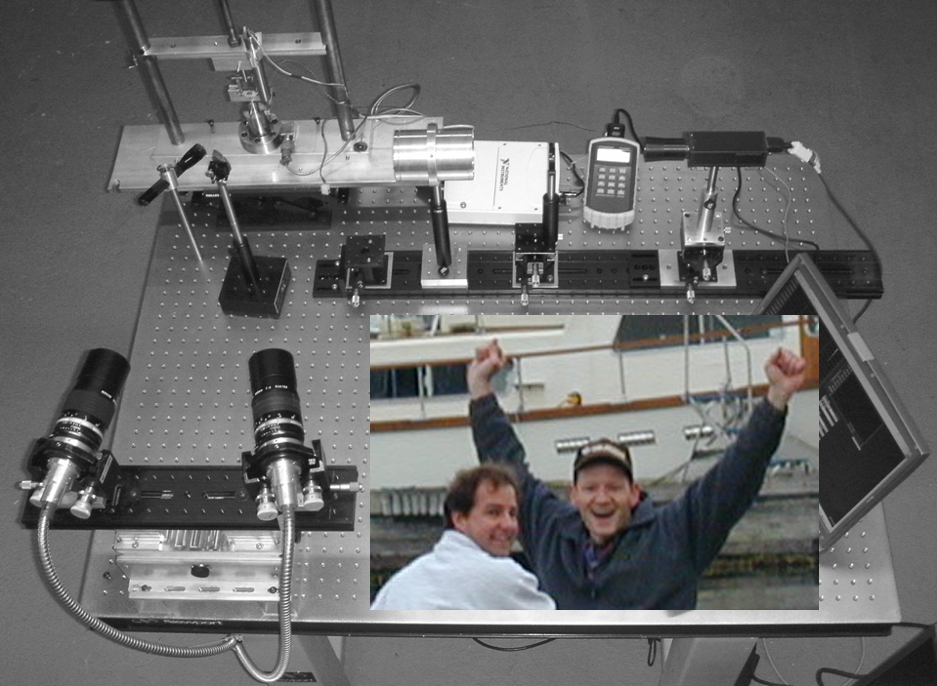
To address these concerns, we’ve developed sophisticated methods in our laboratory to study the initiation of cracks in Nitinol.  We have studied closely fatigue loading of carefully designed coupon samples to differentiate between cracks forming in austenite, martensite and mixed phase conditions.  Usisng closed loop cyclic loading and real time interferometric measurements we continue to make advances in understanding the complex fatugue behavior of implantable metal alloys.

You can download a draft of our paper to be published in the second ASTM Special Technical Publication on Metallic Medical Implant Alloys.

Share/Save/Bookmark

Comments
No Comments »
Categories
Engineering
Tags
Fatigue, FEA, Medical Devices, Moire Interferometry, Nitinol
Comments rss Comments rss
Trackback Trackback

« Previous Entries

Stay Updated!

Your email:


Recent Posts

  • FEA and the FDA
  • Identifying Worst Case Device Sizes
  • FEA of NIKE AIR
  • Contact Interaction for Medical Implants
  • Interpreting FEA Results: Integration Point Data
  • Evaluating Design Instabilities with FEA
  • FEA Geometry and Edge Detail
  • Finite Element Optimization of Medical Implants
  • The Selection of Nitinol Material Models for FEA Simulations
  • Metallic Medical Implant Material Fatigue Research
  • Teaching Kindergarten and Elementary School Mathematics
  • Recent Moire Interferometry Experiments
  • Biomimetics/Biomimicry: State of the Art
  • Medical Imaging Data and Computational Fluid Dynamics
  • Suture Clip for Percutaneous Mitral Valve Repair

Categories

  • Engineering (40)
  • Health & Education (6)
  • Innovation (12)
  • Legal (1)
  • Personal (5)

Tags

ABAQUS ASTM F04.30.06 Biomimicry Boats Design Dr. Paul Education EEG Fatigue FDA FEA Innovation Intrapreneuring Irene Legal Materials Medical Medical Devices Moire Interferometry NIKE Nitinol NLP nonlinear Optimization Patents Personal SEM SMST Stent Stents validation

Engineering

  • Device Testing
  • Finite Element Analysis

Health & Education

  • Bainbridge Island Graduate Institute
  • Eating Small Potatoes
  • EEG Neurofeedback Systems
  • NLP University

Innovation

  • Intrapreneuring Article
  • NIKE’s Sustainability Initiative
  • Pinchot & Company
  • The Truth About CO2
  • Transition States

Subscribe

  • Register with Dr. Perry

Meta

  • Register
  • Log in
  • Entries RSS
  • Comments RSS
  • WordPress.org
  • [Un]Subscribe to Posts
web product development rss Comments rss valid xhtml 1.1 Creative Commons License
All Rights Reserved ⓒ2009 Terms Of Use