FEA of NIKE AIR

My first job out of graduate school and post-doctorate work was with the footwear company, NIKE.  I was fortunate to hire into the heart of the most advanced footwear technology department in the world and I could not have had a more exciting job description.  I began by learning how to design NIKE AIR cushioning [...]

Contact Interaction for Medical Implants

There are many circumstances when it is necessary to model contact and contact interactions when analyzing medical implants.  Such circumstances arise when devices interact with tooling, catheters, vessels and when self-contact occurs.  This latter situation arises for example when a stent is crimped down tightly to catheter dimensions.

ABAQUS/Standard provides a range of methods for defining [...]

Interpreting FEA Results: Integration Point Data

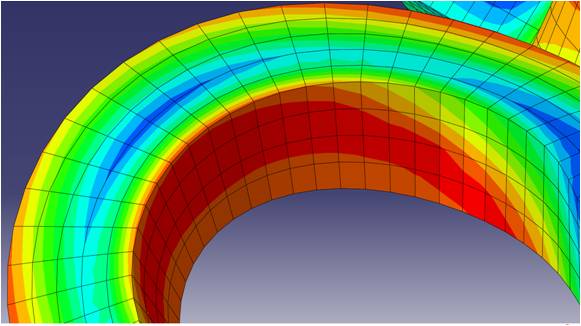
Finite Element Analysis (FEA) can produce an enormous amount of data as output.  Solution variables such as stress and strain are computed throughout an analysis for each increment and at each location within the model.  These solution variables are computed at what are called “integration points”.  These locations ARE NOT the same as the nodes [...]

Evaluating Design Instabilities with FEA

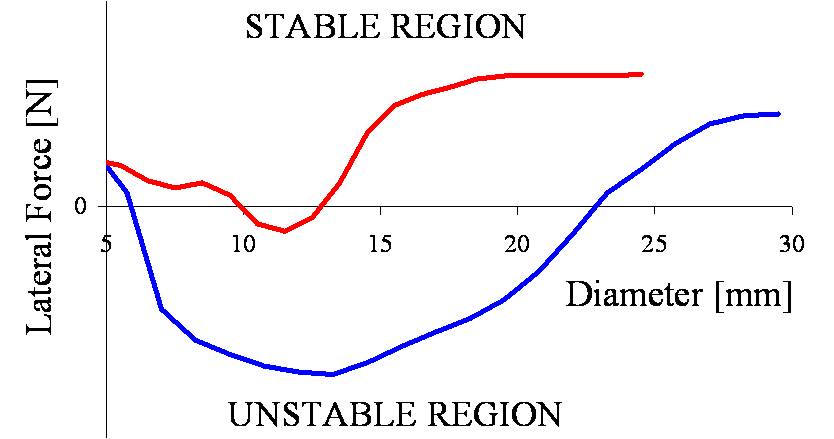
Finite Element Analysis is routinely used to evaluate the performance and durability of medical devices.  When using an implicit method such as ABAQUS/Standard, FEA can also be used to evaluate the geometric stability of a proposed design.  Such issues could arise for example when designing stents for large vessels, such as the aorta, [...]

FEA Geometry and Edge Detail

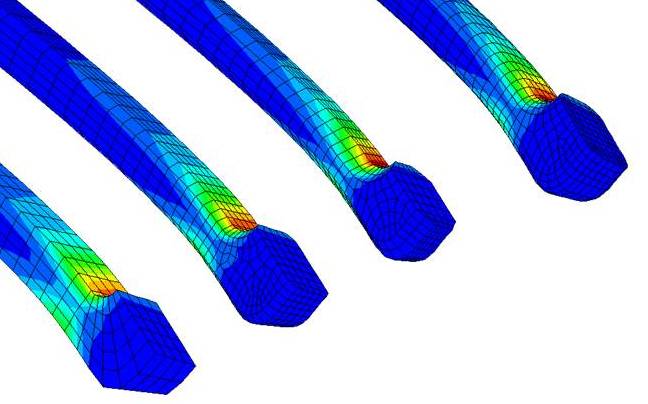
A typical process for making stents is electropolishing to remove material and processing defects and to impart a smooth finish with rounded corners.  It is well known that a polished part will have superior fatigue resistance, but how much does the rounding of edges affect the stress and strain in the stent when loaded?

We studied [...]